Iran nuclear industry owes to martyred Leader’s instructions
| 18/February/2026 | 13:12
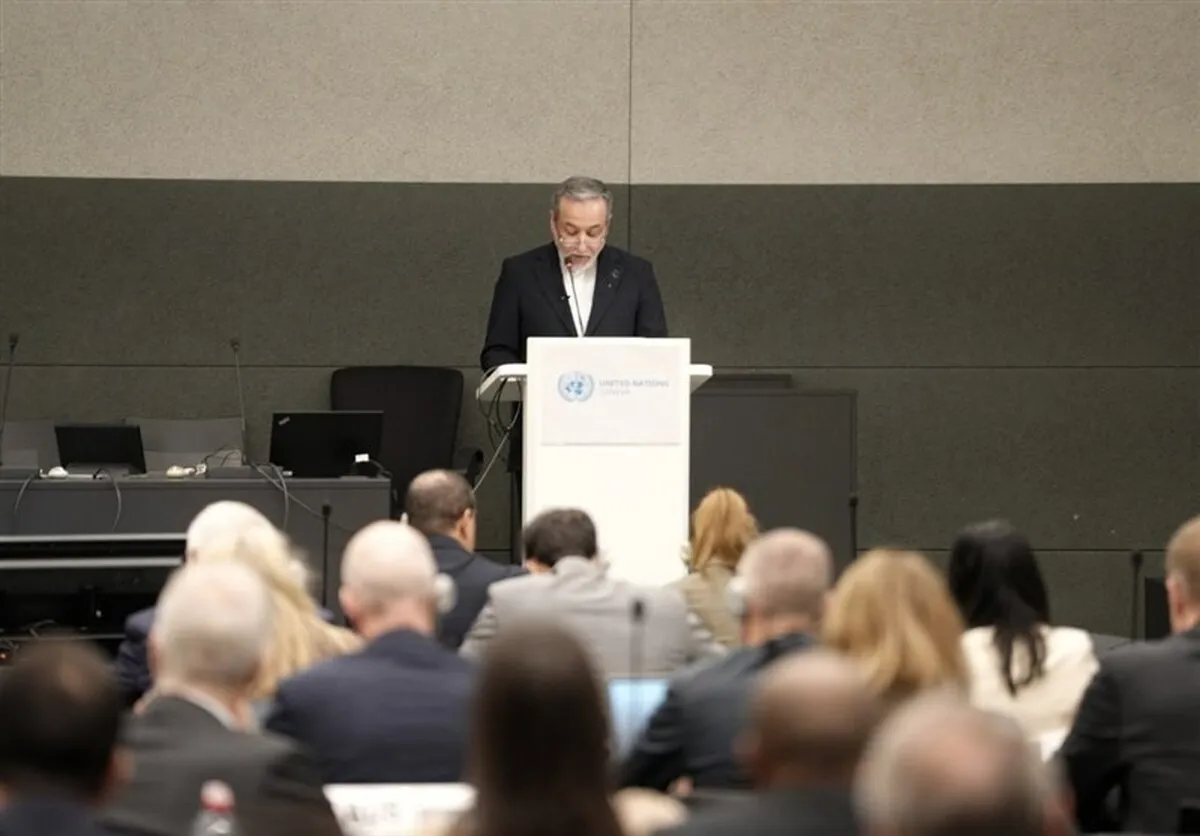
In a speech delivered on February 17 before the plenary meeting of the Conference on Disarmament, held in Geneva, Araqchi warned that the international peace and security architecture is facing unprecedented strain, citing armed conflicts, erosion of multilateralism, and renewed reliance on nuclear deterrence doctrines.
What follows is the full text of his speech:
Thank you, Mr. President.
I truly thank you, Mr. President, for convening this meeting.
I should also thank all of you, distinguished Ambassadors and delegates, for attending this meeting.
I am honored to address the United Nations Conference on Disarmament on behalf of the nation of Iran.
It is an undeniable fact that international peace and security architecture has, particularly in recent years, been confronted with unprecedented strains, erosion, and complex challenges that pose serious risks to global peace and stability.
Escalating armed conflicts, ever-increasing weakening respect for international law and the Charter of the United Nations, erosion of multilateralism, imposition of unlawful unilateral coercive measures, and the renewed reliance on nuclear weapons as instruments of policy have created a highly unstable global environment.
These ever increasing threats and challenges demand urgent collective action, particularly by this conference, which remains the sole multilateral negotiating forum on disarmament.
Nuclear weapons constitute the gravest threat to humanity, and it is a matter of serious concern and deep regret that, contrary to existing international legal obligations for their complete, verifiable, and irreversible elimination, reliance on such weapons is increasingly entrenched in the security doctrines of some States.
Humanity continues to live under the shadow of more than 12,000 nuclear warheads, many of which remain deployed or on high alert, embedded in doctrines that contemplate their rapid use and, in some cases, their first use. The continued reliance on such arsenals reflects doctrines that perpetuate existential risks for all humanity and stand in direct contradiction with disarmament obligations under the Treaty on the Non-Proliferation of Nuclear Weapons (NPT).
Iran has consistently pursued a strategy aimed at the peaceful use of nuclear energy, while demonstrating readiness to address any concerns regarding the nature of its nuclear program and to ensure its exclusively peaceful character. it was on the basis of this logic that Iran entered into nuclear negotiations and has continued until very today. A review of the course of these negotiations speaks volumes.
The Islamic Republic of Iran has consistently affirmed that it neither seeks to manufacture nor to acquire nuclear weapons, which have no place whatsoever in Iran’s national security doctrine. This position is rooted in our defensive policy and reinforced by clear religious boundaries prohibiting weapons of mass destruction.
Mr. President,
Lasting agreements can only be achieved through mutual balanced commitments, and respect for the legitimate rights of nations. The Treaty on the Non-Proliferation of Nuclear Weapons (NPT) explicitly recognizes the inalienable right of all States Parties to develop research, produce, and use nuclear energy for peaceful purposes. This right is inherent, non-negotiable, and legally binding. It is not conditional upon political considerations, nor can it be suspended or reinterpreted arbitrarily. Any attempt to portray this right as revocable or discretionary fundamentally contradicts the letter and spirit of the Treaty.
Despite Iran’s demonstrated commitment to diplomacy and good-faith engagement, the conduct of certain Western states—most notably the United States—has seriously undermined the credibility of the negotiating process. The unilateral withdrawal of the United States from the JCPOA, in clear violation of an internationally endorsed agreement, dealt a profound blow to trust and stability of multilateral obligations. This decision not only disregarded multilateral commitments, but also imposed unjustified economic and humanitarian consequences on the Iranian people.
More troubling still was the recourse to military aggression against Iran in last June, at a time when we were in midst of negotiations. Such aggression stands in stark contradiction to badic principles of UN Charter and international law, in particular paragraph 4 of Article 2 if the Charter.
By colluding with a non-party to the NPT against a State Party, the United States—one of the depositaries of the Treaty—has inflicted a serious blow to the integrity, credibility, and spirit of the NPT, the consequences of which will persist for ever. Attacks on safeguarded nuclear facilities constitute war crimes, carry the potential for radiological release, long-term environmental contamination, and transboundary consequences affecting entire region. The failure of the Security Council and the IAEA to unequivocally condemn these attacks sets a dangerous precedent and signals a serious erosion of the global non-proliferation regime.
Responsibility for such unlawful acts does not rest solely with the direct perpetrators; States that provided political, military or intelligence support bear responsibility under international law for aiding and abetting internationally wrongful acts. Selective condemnation and double standards gravely undermine the credibility of international norms and institutions. Silence in the face of such violations is not neutrality; it is acquiescence.
While the United States and certain European countries turn a blind eye to the threats posed by the Israeli regime to international peace and security, including its nuclear weapons capabilities, they continue to portray Iran’s peaceful nuclear program as a threat to international peace and security.
The Israeli regime has been committing the most atrocious crimes for the past 8 decades with full impunity. In less than 2 years, it has attacked seven countries in the region, while more than 70,000 people have been massacred in Gaza as part of its colonial genocide. There is no crime it has not committed and no red line it has not crossed.
Mr. President,
The US and some European states persist in the imposition of unlawful sanctions, military threats, the engagement in force posturing and the issuance of explicit references to the possible use of force by the United States, including significant military deployments in the region. Such actions constitute a continuing violation of the prohibition on the threat or use of force as enshrined in Article 2(4) of the Charter of the United Nations and must be brought to an immediate and unconditional end.
Mr. President,
Iran has consistently emphasized its commitment to cooperation with the International Atomic Energy Agency within the framework of its legal obligations. Iran is a founding member of the IAEA and a State Party to the NPT. Iran’s peaceful nuclear program has been subject to extensive and unprecedented verification measures under IAEA safeguards.
Our cooperation with the Agency has always been guided by professionalism, transparency, and respect for national sovereignty. Iran believes that constructive engagement with the Agency should remain strictly technical and impartial, free from political pressure or selective interpretation. Continued cooperation can only be sustained when it is reciprocal, objective, and contributes genuinely to confidence-building rather than being used as a tool for political leverage.
Meanwhile, it should be forgotten that attacks on safeguarded nuclear installations are entirely unprecedented. Neither the IAEA Statute nor the Comprehensive Safeguards Agreement provides guidance on inspection modalities for nuclear facilities that have been subjected to such attacks. Accordingly, inspections of these facilities require a mutually agreed framework between Iran and the Agency. This is something that we are working on that. In this spirit, yesterday I had a technical discussion with Rafael Grossi, Director General of the Agency, where we discussed cooperation between Iran and the Agency.
Iran will continue its constructive dialogue and engagement with the Agency to address these technical issues and to identify an agreed pathway for closing the outstanding gaps.
Distinguished Delegates,
Iran has always been prepared to engage in meaningful and results-oriented negotiations. Any sustainable agreement must ensure the full recognition of Iran’s legitimate rights, deliver tangible benefits, and be safeguarded against unilateral actions that undermine trust and credibility.
According to these principles and as a result of the good offices by our friendly countries in the region which we are very grateful, a new window of opportunity has opened under which we had the second round of the negotiations with the United States earlier today here in Geneva. We are hopeful that negotiation will lead to a sustainable and negotiated solution which can serve the interest of relevant parties and the broader region.
At the same time, as demonstrated during the aggression of 12 June 2025, Iran remains fully prepared to defend itself against any threat or act of aggression. The consequences of any attack against Iran will not be confined to its borders.
To conclude, Mr. President, I would like to emphasize that the Conference on Disarmament must overcome its paralysis and fulfill its mandate through the commencement of negotiations on a comprehensive nuclear weapons convention as an urgent necessity. Accountability is not punitive; it is preventive. Inaction in the face of nuclear threats, aggression, and double standards undermines the very foundations of international law. The choice before us is clear: either we dismantle nuclear weapons, or they will one day dismantle us. Together, we can work to achieve a world free of nuclear weapons.
Thank you, Mr. President/tasnim