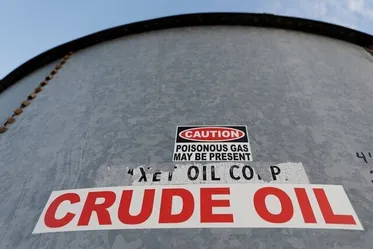
Oil Drifts Near 2018 Highs
| 17/June/2026 | 20:19

While the political breakthrough fueled market optimism, lingering uncertainties regarding the absolute normalization of commercial shipping through the Strait of Hormuz limited deeper price declines.
Brent crude futures slipped 16 cents, or 0.2 percent, to trade at 78.80 dollars per barrel, while US West Texas Intermediate (WTI) crude futures dropped 25 cents, or 0.3 percent, to stand at 75.80 dollars per barrel. Backed by growing expectations that the US-Iran diplomatic understanding will secure stable energy flows through the Persian Gulf, both global benchmarks had already plummeted roughly 5 percent on Tuesday for a second consecutive session, hitting their lowest levels in three months.
Priyanka Sachdeva, a senior market analyst at Phillip Nova, noted that energy markets are broadly unwinding the geopolitical risk premium that had been priced into crude over the past months. However, she observed that the path toward full maritime normalization remains complex, pointing out that while political agreements are visibly progressing, the physical transit of oil tankers through the critical Strait of Hormuz has not yet fully recovered to pre-conflict levels.
Hiroyuki Kikukawa, the chief strategist at Nissan Securities Investment, stated that oil markets retraced on expectations of a full reopening of the chokepoint following the memorandum. Nonetheless, he added that traders are avoiding further aggressive short-selling until additional technical details are officially disclosed, predicting that WTI crude will likely remain volatile within a ten-dollar range above or below the 80-dollar-per-barrel mark.
Prior to the American-Zionist aggression against Iran which triggered the closure of the strategic waterway, roughly one-fifth of the world's total supply of crude oil and liquefied natural gas (LNG) transited regularly through the Strait of Hormuz.
According to a report by Reuters, industry sources stated that data from the American Petroleum Institute (API) indicates US crude inventories dropped sharply by 8.3 million barrels for the week ending June 12, significantly exceeding market forecasts of a 4.6 million-barrel decline. The official inventory data is scheduled for publication later today by the US Energy Information Administration (EIA).
Wall Street Banks Revise Global Oil Price Forecasts Downward
In the wake of the US-Iran memorandum announced earlier this week, prominent investment banks including Morgan Stanley, Goldman Sachs, and Citigroup have significantly revised and lowered their oil price projections for the remainder of 2026 and fiscal year 2027.
Bloomberg reported, citing a research note from the commodities team at Morgan Stanley, that the bank now projects Brent crude to average 90 dollars per barrel in the third quarter before sliding to 80 dollars per barrel in the final quarter of this year. Morgan Stanley's previous forecast had placed third-quarter Brent at a higher average of 100 dollars per barrel.
Concurrently, Goldman Sachs slashed its fourth-quarter crude forecast from 90 dollars down to 80 dollars per barrel, while reducing its projected average price for Brent in 2027 from 80 dollars to 75 dollars per barrel. Commodity analysts at Goldman Sachs expressed confidence that commercial tanker traffic through the Strait of Hormuz will be completely restored by the end of July.
Taking an even more bearish stance, Citigroup aggressively downgraded its Brent crude forecasts on Monday, cutting its third-quarter estimate to 75 dollars per barrel and its fourth-quarter expectation to an average of 70 dollars per barrel. Looking ahead to 2027, Citigroup expects Brent to average 65 dollars per barrel, a steep drop from its previous long-term baseline projection of 80 dollars per barrel./isna