Iran Resolutely Pursuing End of War on Lebanon: Qalibaf
| 04/December/2025 | 20:10
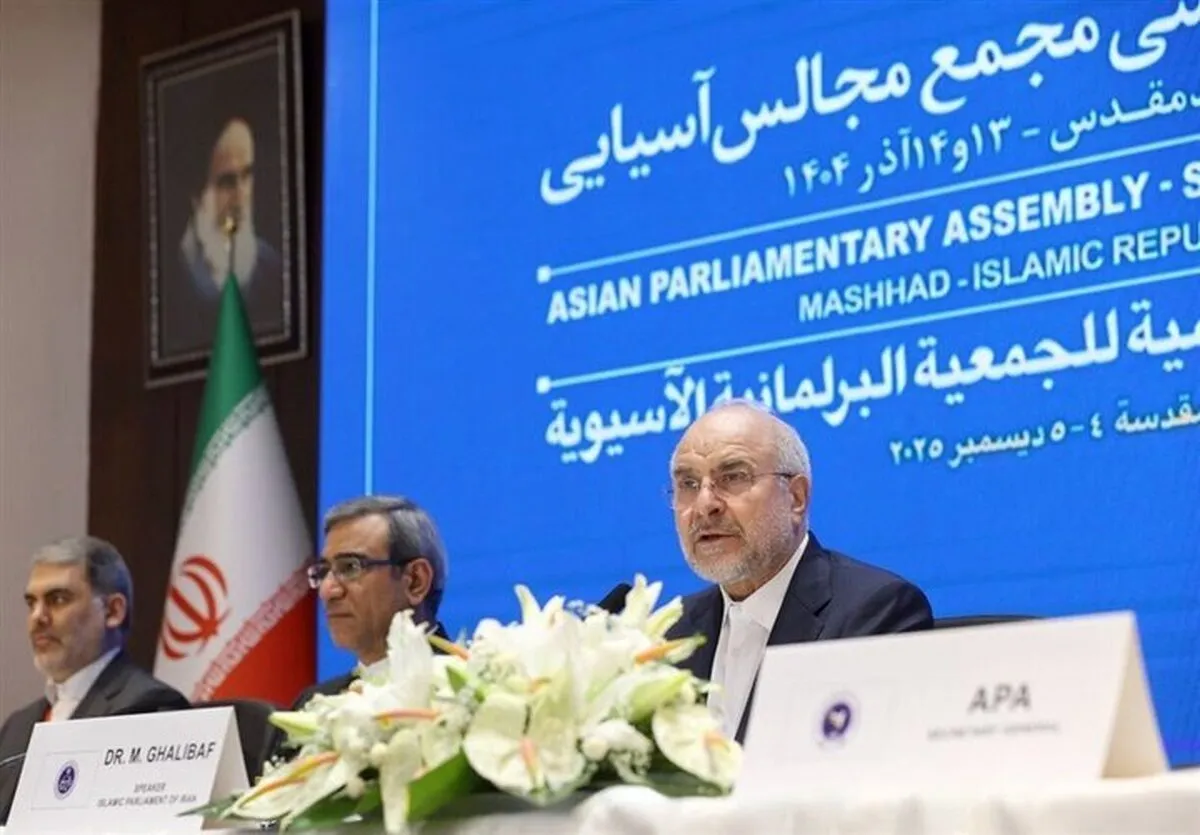
Iran’s Parliament Speaker Mohammad Bagher Ghalibaf said Iran remains committed to diplomatic engagement but will never negotiate under pressure, despite years of hostile policies targeting the country and the June 2025 Israeli attack on Iranian nuclear and civilian facilities.
Speaking at the meeting of the Permanent Committee on Political Affairs of the Asian Parliamentary Assembly (APA), Ghalibaf said that over recent decades the Iranian nation has been subjected to one of the most intense and organized hostile campaigns in contemporary history. These include what he described as “inhumane sanctions,” efforts to obstruct Iran’s peaceful scientific and nuclear progress, and ultimately the “cowardly” direct attack carried out by Israel in June 2025 with “explicit US involvement.”
He said the strike occurred in the middle of diplomatic negotiations, while some European governments, instead of condemning the aggressor, “stood with the occupier.” In contrast, he noted that 120 countries around the world denounced the attack and voiced support for the Iranian people.
According to Ghalibaf, the stance of Western governments clearly demonstrated that, for them, diplomacy is not a tool for dialogue or resolving disputes, but rather “an instrument for deception, buying time and applying pressure.”
He emphasized that under no circumstances will the Islamic Republic of Iran place its national security, defensive capabilities or its legitimate right to progress on the negotiating table. “We have repeatedly announced that the doors of diplomacy remain open,” he said. “But real diplomacy is only meaningful when it is accompanied by mutual respect and shared interests, not coercion and threats.”
Ghalibaf also addressed broader regional issues, saying Asia is positioned at a historic moment amid deep political, economic, technological and cultural transformations reshaping the world. He said Asia is not merely a geographic region but a continent defined by profound historical, cultural, economic and political connections among its nations.
He argued that with sufficient regional and global awareness of the world’s current challenges—and through collective, interest-based cooperation—Asia can present a new model of regional partnership and emerge as the center of gravity for economic growth, future-oriented innovation and global developments.
According to Ghalibaf, Asia’s significance does not lie solely in its population size or landmass, but in its intellectual independence, cultural diversity and the shared determination of its countries to pursue genuine multilateralism./mehr